
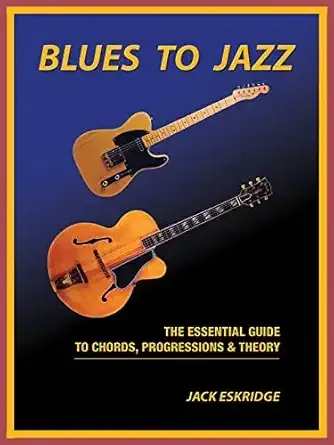
An Instructional Book by Orinda Guitar Teacher Jack Eskridge. Practical guidebook designed to help guitarists transition their blues vocabulary into jazz contexts. The book offers exercises, transcriptions, harmonic explanations, and applied examples that bridge the gap between raw blues licks and sophisticated jazz improvisation. It reflects Jack’s decades of teaching experience and provides players with clear, actionable strategies to expand their expressive range.
Jack Eskridge's Instructional Book
Blues to Jazz — Jack Eskridge Guitar Lessons, Orinda CA
Why Blues to Jazz Matters
Many guitarists are comfortable with pentatonic and blues vocabularies but find jazz harmony intimidating. Blues to Jazz demystifies this transition by focusing on:
Direct, practical applications of blues phrases over jazz changes
Step-by-step harmony explanations that avoid excessive theory
Musical exercises that develop voicing awareness and melodic choices
This approach helps players retain the emotional directness of blues while navigating the complexities of jazz harmony.
Who the Book Is For
Intermediate players comfortable with pentatonic scales who want to grow into jazz contexts.
Jazz guitar students seeking blues-based melodic tools.
Blues players looking to expand harmonic awareness and improvisational options.
Teachers and students seeking a structured bridge between styles.
Key Benefits of Studying Blues to Jazz
Practical Harmonic Tools
Learn how to apply pentatonic and blues phrases over ii-V-I progressions and other jazz forms.
Melodic Development
Exercises focused on motif development, tension and release, and melodic contour in harmonic contexts.
Voicing Awareness
Understand how chord voicings change the landscape for improvisation and learn strategies to target chord tones effectively.
Ear Training
Activities designed to improve aural recognition of harmonic movement and melodic function.
Applied Transcriptions
Examples from classic blues and jazz players with commentary and suggested practice routines.
Stepwise Progression
The book is written for players at multiple levels, with sections that scaffold concepts from simple to complex.
How the Book Is Organized
Blues to Jazz is structured into distinct modules to make learning systematic:
Foundations
Basic blues scales, phrasing, and rhythm essentials.
1
Harmonic Mapping
Understanding chord changes, guide tones, and voice-leading.
2
Application
Translating blues motifs into jazz contexts with exercises and examples.
3
Repertoire
Examples and transcriptions of pieces bridging blues and jazz idioms.
4
Practice Routines
Daily and weekly practice plans to internalize concepts efficiently.
5
Sample Content
(Representative Topics)
Turning Blues Licks into Jazz Lines
Exercises that reharmonize pentatonic licks over ii-V-I progressions.
Guide-Tone Soloing
Solos built around guide tones and voice-leading.
Bluesy Chromaticism
How to incorporate chromatic approaches and enclosures in solos.
Comping with Character
Using blues sensibilities when comping in jazz contexts.
Developing a Personal Voice
Exercises aimed at integrating blues phrasing into a broader harmonic palette.
Why Jack Wrote Blues to Jazz
Jack observed many students stuck at a stylistic boundary: they had expressive blues vocabulary but lacked tools to move into jazz contexts. He wrote Blues to Jazz to give players a clear roadmap: practical, musical, and immediately applicable. The book distills decades of teaching into exercises and concepts that produce tangible improvements.
How the Book Supports Lesson Work
Blues to Jazz complements private lessons perfectly. Jack uses the book's exercises within lessons to target specific areas of a student’s playing. When combined with one-on-one coaching, the book accelerates learning by providing structured practice and multiple contextual examples.
Start Your Jazz Guitar Lessons
Interested in Blues to Jazz or other instructional materials? Call (925) 933-3111 to ask about purchasing the book or request a copy for lesson use. You can also visit the Book page to learn more and arrange to buy a copy.
Frequently Asked Questions
What level is Blues to Jazz aimed at?
The book is aimed primarily at intermediate players but includes foundational sections that are accessible to motivated beginners and advanced readers seeking new perspectives.
Do I need formal theory knowledge to use the book?
No. The book explains necessary concepts in an applied way and uses clear examples so players can learn by doing.
Does the book include transcriptions?
Yes. It contains transcriptions of phrases and solos, with suggested practice approaches and musical commentary.
Is the book used in Jack’s lessons?
Yes. Blues to Jazz is a recommended resource for students studying blues and jazz with Jack.
How can I obtain a copy?
Contact the studio at (925) 933-3111 or use the form on the Contact page to ask about availability and purchase options.